Match Report
The Match Report evaluates how closely your resume aligns with the job description, using a scoring algorithm that mimics how Applicant Tracking Systems (ATS) score resumes.
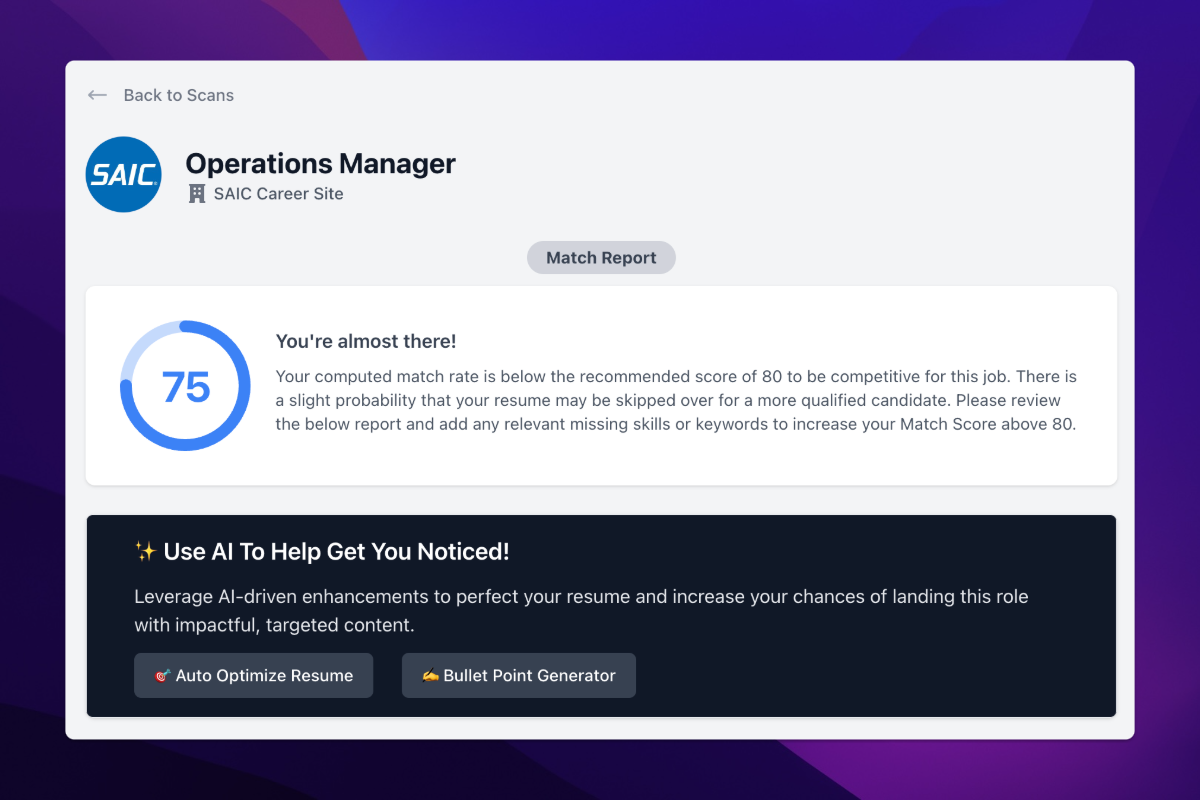
Scoring Components
Skill Grouping
We group similar spellings, plurals, and word stems to provide a comprehensive view of your skill set. The word displayed is the first one found in the job description.
For example, Communicate will encompass all related forms, such as:
"Communication": ["Communicating",, "Communication", "Communications", "Communicator", "Communicators", "Communicate", "Communicated", "Communicative"].
1. Hard Skills
Definition: Hard skills are technical abilities essential for performing the job, such as software proficiency, certifications, or specific technical knowledge (e.g., "Applicant Tracking Systems").
Impact on Score: Hard skills have the highest impact on your match score. Including missing hard skills will significantly improve your score.
Scoring Process: The algorithm compares the skills listed in your resume against the job description. If skills are missing, it increases the discrepancy score. The algorithm prioritizes the addition of hard skills for a higher impact on the overall match score.
2. Soft Skills
Definition: Soft skills refer to interpersonal abilities, such as communication, teamwork, and leadership (e.g., "Interviews").
Impact on Score: While soft skills are important, they have a lower impact on the match score compared to hard skills. However, missing key soft skills may still hurt your match.
Scoring Process: Soft skills that are missing from your resume are flagged. Although their absence doesn’t drastically reduce the score, it indicates areas where your resume could be better aligned with the job description.
3. Other Skills
Definition: Other skills include any additional relevant capabilities that don’t fall under hard or soft skills (e.g., "Customization").
Impact on Score: Other skills contribute to the match score but with a lower weight compared to hard and soft skills.
Scoring Process: Similar to soft skills, missing other skills reduce the score slightly. The scoring algorithm considers the frequency and relevance of these skills within both the job description and your resume.
4. Job Title Match
Definition: The job title mentioned in the resume should match the job title in the job description.
Impact on Score: ATS systems prioritize job titles when determining if the resume is relevant to the role. A job title mismatch can reduce the relevance of your application.
Scoring Process: The algorithm checks if the job title in your resume matches the job title in the job description. The more accurately the job title is included (e.g., in the resume summary or job history), the higher the score.
5. Degree and Experience Match
Degree: If the job description specifies a degree requirement, it should be reflected in your resume.
Experience: Your resume should match the required years of experience listed in the job description.
Impact on Score: ATS systems often use degree and experience as essential filters to determine if a candidate is qualified for a role.
Scoring Process: The algorithm compares the degree and experience levels in your resume to those mentioned in the job description. A match will positively impact the score, while a mismatch may lower it.
Skills Breakdown
Skills are categorized into two groups for scoring purposes:
Skills Not Found in Resume:
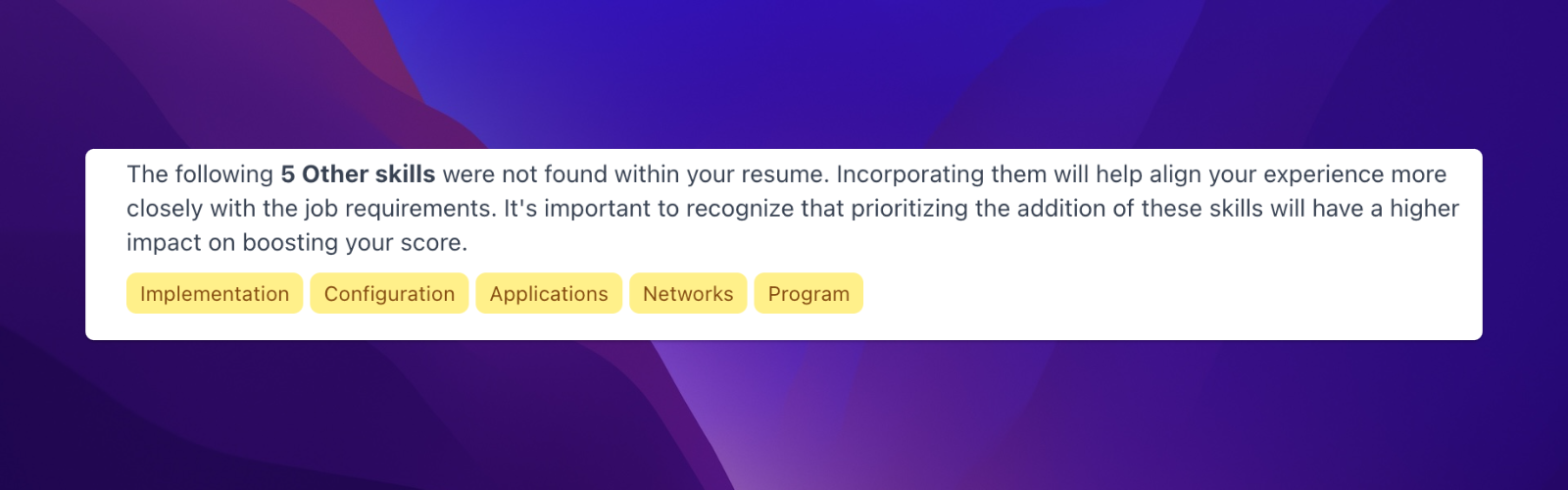
These are skills listed in the job description that are missing from your resume.
Impact on Score: These missing skills are weighted heavily because they directly affect your ability to meet job requirements. The algorithm assigns a higher weight to the addition of these skills.
Skills Found in Resume but Not in the Job Description Frequency:
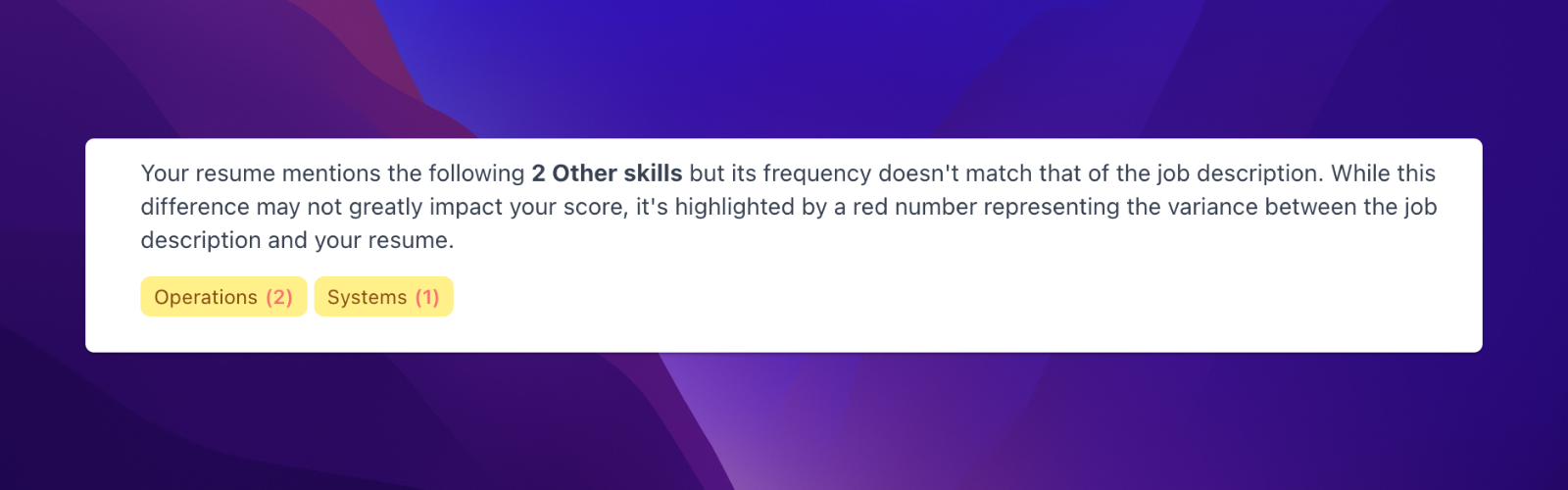
These are skills that appear in your resume but in different frequencies than the job description.
Impact on Score: While this doesn't drastically affect the score, a large disparity in the frequency of certain skills may reduce the match. The algorithm tracks the variance between the frequency of skills mentioned in your resume versus the job description and highlights this difference with a red number to show where adjustments can be made.
Match Score Algorithm
The match score is calculated using a weighted algorithm that prioritizes the most important factors (e.g., hard skills, job title) and considers the presence and frequency of skills, job titles, degrees, and experience. The scoring system is designed to emulate how ATS systems rank resumes based on relevance to the job description.